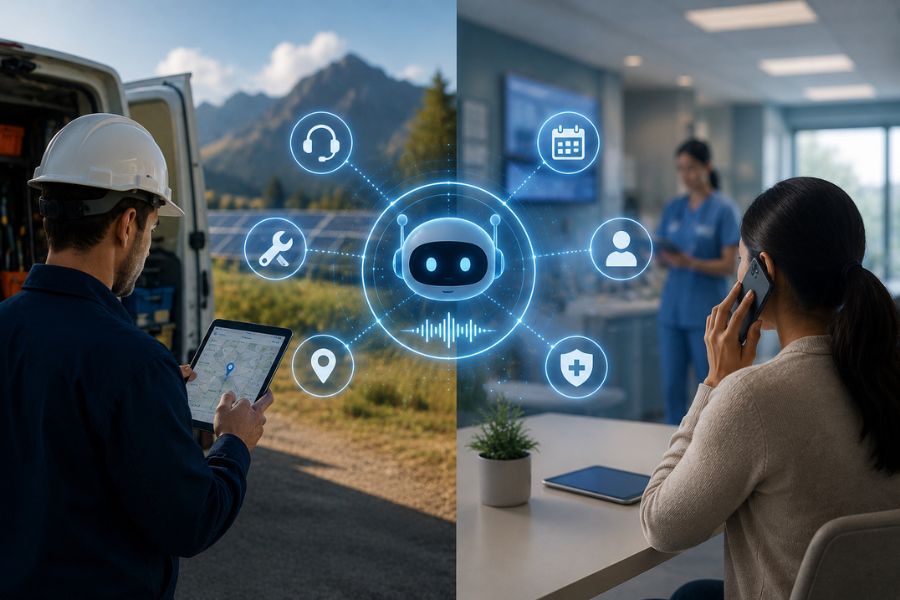
80% of Service Inquiries Still Start with a Phone Call. Agentforce Voice and Self-Service Are About to Change That for Field Service and Healthcare Teams.
Most of the conversation around Salesforce’s Summer ’26 release has focused on Agentforce Voice and Self-Service in the context of general customer support — call deflection, ticket volume, faster resolution. That framing undersells where these capabilities matter most. For organizations running Field Service Lightning or Health Cloud, voice and self-service automation aren’t incremental efficiency gains; they hit the two highest-friction, highest-cost processes in the entire operation: getting a technician to the right job at the right time, and getting a patient or member the right information without a thirty-minute hold.
Salesforce’s own data point — that roughly 80% of service inquiries still begin with a phone call — is even more pronounced in field service and healthcare than in general B2B support. A customer waiting on a technician wants a human-feeling answer about timing, not a self-service portal they have to dig through. A patient calling about an appointment or a prescription refill is, by definition, often anxious or in discomfort, and a frustrating automated phone tree is one of the most reliably cited drivers of patient dissatisfaction. These are exactly the conditions Agentforce Voice was built to handle better than legacy IVR systems — natural, two-way conversation that can actually resolve the request rather than route it.
Consider three concrete use cases. The first is appointment and dispatch triage: a Field Service Lightning deployment where Voice handles inbound calls about technician arrival windows, reschedules, or service status, pulling directly from real-time dispatch data rather than a static FAQ. The second is technician-facing scheduling assistance, where a self-service agent helps field technicians manage their own day — confirming next jobs, flagging parts shortages, escalating complex cases — without routing every minor question through a dispatcher. The third, specific to Health Cloud, is patient self-service intake: appointment scheduling, prescription refill status, and basic eligibility questions handled conversationally, with clear, immediate escalation to a human for anything clinical.
That last clause — clear, immediate escalation to a human for anything clinical — is the single most important design constraint in this entire category, and it’s worth dwelling on. Field service and healthcare are both environments where an automated system getting something wrong isn’t just an inconvenience, it can be a safety or compliance issue. A misrouted dispatch wastes a technician’s day and a customer’s patience. A misrouted clinical question handled by an agent that wasn’t supposed to answer it at all is a different order of risk entirely. Any agentic self-service deployment in these domains needs explicit, tested boundaries around what the agent is permitted to answer, what it must escalate, and how that handoff happens without the customer having to repeat their entire situation to a human — which is precisely the shared-context problem multi-agent orchestration in this release is meant to solve.
Compliance and governance considerations layer on top of the technical design. Health Cloud deployments operate under HIPAA constraints that govern exactly what an agent can access, log, and say, and any voice or self-service agent touching patient data needs an audit trail robust enough to satisfy a compliance review, not just an engineering sign-off. Field service environments carry their own version of this in regulated industries — utilities, telecom infrastructure, medical equipment servicing — where a dispatch error can have downstream safety implications. None of this is a reason to avoid agentic self-service in these domains. It’s a reason to design escalation paths and human-in-the-loop checkpoints before launch, not after an incident forces the issue.
The organizations that get this right tend to start with the narrowest, lowest-risk use case — appointment confirmation or status lookup, not anything diagnostic or prescriptive — prove out the escalation path with real call volume, and only then expand scope. That sequencing matters more here than in general customer service, because the cost of a bad outcome is asymmetrically higher in healthcare and field operations than in, say, a retail support queue.
Selectiva Systems has deep, specific experience in both Field Service Lightning and Health Cloud implementations, and our approach to agentic self-service in these domains starts with compliance and escalation design, not feature configuration. We’ve built the governance frameworks that let healthcare and field service organizations adopt Voice and Self-Service responsibly — capturing the efficiency gain without inheriting the risk that comes with deploying too fast in a regulated environment.
The timing argument matters here too. Because Voice and Self-Service are new enough that few field service or healthcare organizations have deployed them at scale yet, there’s a genuine window to set the standard for responsible adoption in your sector before a competitor’s poorly governed rollout creates a public incident that puts regulators and patients on alert for everyone. Moving deliberately now is also moving early relative to the rest of the market.
Schedule a consultation with Selectiva’s Field Service & Health Cloud practice to scope your first agentic self-service use case.