Every AI initiative eventually runs into the same wall: the data isn’t ready. It lives in three different systems. Half of it is stale. The customer records don’t match across platforms. The marketing team is working from a different source of truth than the sales team. Until that problem is solved, AI produces noise rather than signal.
This is not a new observation. Data quality and unification have been on enterprise priority lists for years. What has changed is the stakes. In 2026, fragmented data doesn’t just make reporting harder — it actively limits what your AI can do. Agentforce is only as intelligent as the data it can access.
What Salesforce Data Cloud Actually Does
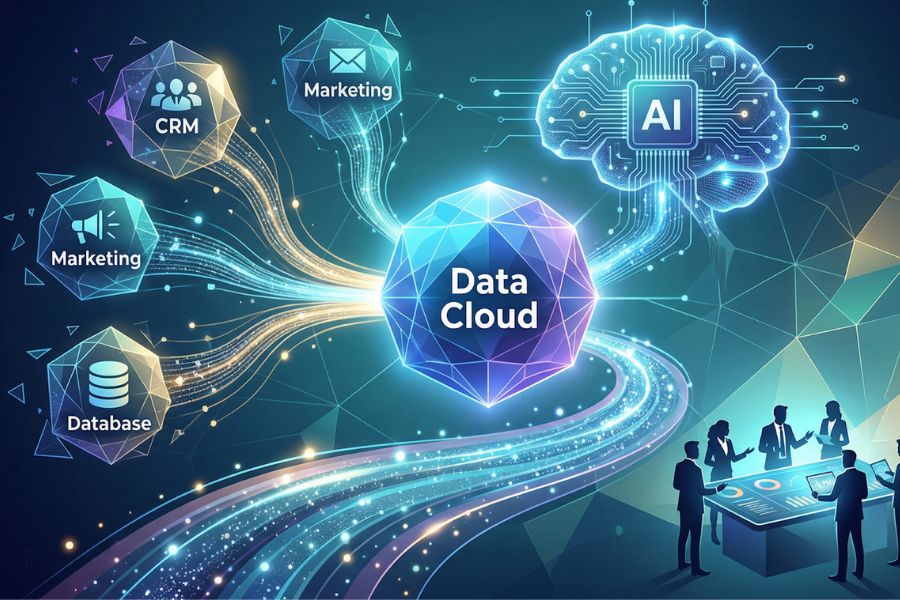
Data Cloud is Salesforce’s customer data platform. It ingests data from multiple sources:
- Salesforce objects
- Third-party applications
- Website events
- Transaction systems
- External databases
It unifies all of this around a single customer identity. A contact in your CRM, a customer in your e-commerce platform, and a subscriber in your email tool can be recognised as the same person, with a single, consolidated profile.
This unified profile becomes the fuel for every AI capability in the Salesforce ecosystem:
- When Agentforce builds an account briefing, it draws from Data Cloud.
- When Einstein personalises a marketing message, it draws from Data Cloud.
- When a service agent makes a recommendation, it draws from Data Cloud.
Get the foundation right and everything built on top of it improves.
What Spring ’26 Added
Deeper integrations with Snowflake and Databricks mean enterprises can now unify customer data without heavy data movement. If your analytical data sits in a Snowflake warehouse, you no longer have to duplicate it into Salesforce — Data Cloud can query it in place, reducing:
- Latency
- Storage costs
- Risk of data drift between systems
The new Agentic Setup and Data Management capability in Data 360 automates the orchestration of data pipelines with AI-guided suggestions. What used to require a data engineer to configure manually can now be assembled with intelligent assistance:
- Connection mapping
- Transformation logic
- Activation rules
The pipeline becomes faster to build and easier to maintain.
The Global East Context
Businesses in the Gulf face a specific data challenge. Many are multi-entity organisations — a group structure with subsidiaries across different sectors, often spanning multiple countries. Key challenges include:
- Customer data scattered across business units
- Legacy systems from different eras coexisting without meaningful integration
- Fragmentation as the first obstacle when deploying AI across a portfolio
Data Cloud addresses this directly. It can ingest data from disparate systems, apply a unified identity resolution model, and present a consolidated view of customers across the group. For organisations building toward an AI-powered enterprise, this is not optional infrastructure — it is the prerequisite.
Start With a Data Readiness Assessment
Before investing in AI capabilities, the most valuable step is understanding what your data actually looks like. Key questions to answer:
- Where does your data live?
- How complete is it?
- How consistent are the identifiers across systems?
- What gaps exist between what you have and what your AI use cases will require?
This assessment typically reveals a mix of quick wins and structural issues:
- Quick wins can be addressed in the short term, delivering immediate improvement.
- Structural issues require a roadmap — but knowing they exist is far better than discovering them after an AI deployment has already failed to deliver.
Selectiva Systems has delivered Data Cloud implementations for clients ranging from single-entity SMEs to regional conglomerates. Our approach starts with the data reality, not the marketing ideal, and builds a path that is achievable within your organisation’s capacity to change.
Let’s assess your data readiness. Book a consultation with Selectiva Systems.
Visit us at www.selectivasystems.com to learn more about how we can help your business.